
The Kettlebell Swing: The Most Underrated Strength + Conditioning Move You’re (Probably) Doing Wrong
If there’s one move that delivers a ridiculous return on investment, it’s the kettlebell swing. One bell. One movement pattern. Endless benefits—fat loss, power, cardio, strength, and better posture all rolled into one.
But here’s the catch: the swing is simple, not *easy. *And when you learn how to do it well? Your workouts—and your body—change fast.
Let’s break down why the swing is such a powerhouse, how it works, the biggest mistakes people make, and how to start mastering it the Studio ME way.
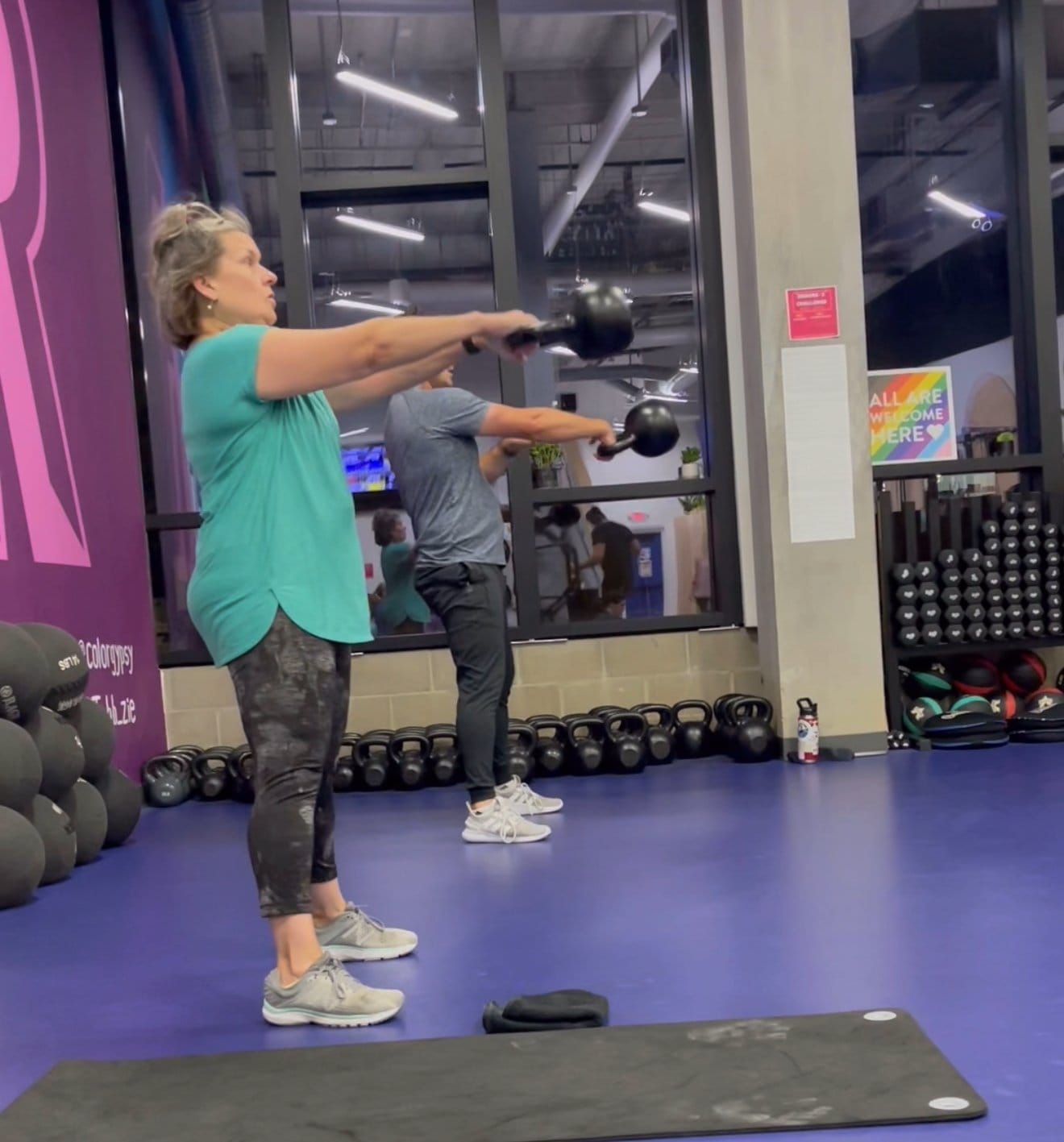
Sue and Jake at the top of their swing in a nice tight standing plank.
Why the Kettlebell Swing Should Be in Everyone’s Program
1. The Best Single Exercise for Fat Loss
If fat loss is your main goal, swings should be at the top of your list. A well-performed swing recruits 600+ muscles at once. That’s a lot of tissue demanding energy… which means you’re burning a ton of calories in a short amount of time.
Think of it like lighting a match: the swing is the spark, and your metabolism is the flame that stays lit long after your workout ends.
2. Cardio Without Taking a Single Step
Rowers know the feeling of redlining without moving anywhere. Swings deliver that same “my lungs are on fire” sensation—fast.
Within 30–60 seconds, your heart and lungs are working hard to meet the demand. It’s sprint-level conditioning without pounding your joints, which is why we love it for longevity and active aging.
3. Strength Gains Come Quickly
The swing is loaded eccentric training: your muscles lengthen under load every rep as you absorb the bell’s force. That means:
- More strength
- More power
- More soreness (the good kind)
The posterior chain—the glutes, hamstrings, and back—gets absolutely rocked, and these muscles are your biggest, strongest movers. When they get stronger, everything in life gets easier.
4. Surprisingly Shoulder- and Knee-Friendly
People assume swings are “hard on the back.” In reality, most folks feel better when they learn to do them correctly.
Why?
- The swing pulls your shoulder joints apart slightly, and your stabilizers learn to hold everything together. That’s rehab-level strengthening.
- Your knees barely bend, which makes the swing a great option if squats and lunges bother your joints.
This is why we program swings often at Studio ME—they’re accessible, scalable, and joint-friendly when taught well.
5. Explosive Power Builder
Sports, hiking, running, stairs, pickleball—everything gets easier when your hips can generate force quickly.
The swing teaches you how to release energy like a spring. Fast hips = power. Power = strength you can actually use.
6. You Can Do It Anywhere
A 6ft x 6ft space is all you need. Your feet stay planted, the bell follows a tight arc, and you can get a killer workout in your garage, living room, or office.
7. One Bell = Endless Progression
Start with two-handed swings. Then move to one-handed. Then lateral. The same bell can keep you challenged for years if you progress intentionally.
Muscles Worked: Why the Swing Is So Effective
The swing is a back-of-the-body powerhouse:
- Glutes
- Hamstrings
- Hips
- Core
- Lats and upper back
- Shoulder stabilizers
The only thing it doesn’t hammer is the chest (and that’s actually a good balance for modern posture).
A neutral spine is key—your back acts like a plank, not a lever. If your low back is sore, you're bending there instead of hinging at the hips.
Choosing the Right Starting Weight
You want a bell that’s heavy enough to give you feedback but not so heavy it yanks you around.
Recommended starting weights:
- Women: 8kg (15lb) / Athletic: 12kg (25lb)
- Men: 12kg (25lb) / Athletic: 16kg (35lb)
Too light? You won’t learn good mechanics. Too heavy? You’ll muscle the movement and skip the hinge.
Master the Hip Hinge First
Before you ever touch a bell, you need a good hinge.
Key cues:
- Push your hips back like you’re closing a car door with your butt
- Keep your spine long
- Shins stay mostly vertical
- Eyes 45° ahead
- Snap your hips forward to stand tall
We use bars, towels, partner drills, wall taps, and even slips of paper to teach good hinge mechanics at Studio ME. Every drill builds awareness and power.
13 Essentials for a Great Swing (Without the Overwhelm)
Here’s the short version of what matters most:
- Feet just wider than shoulders—toes slightly turned out.
- Hips are the engine—they move forward/backward, not up/down.
- Flat back always—if it rounds, you’ve gone too far.
- Abs on at the top—brace like someone’s going to poke you.
- Relax the shoulders—your arms are hooks, not lifters.
- Neutral neck—gaze shifts as your torso moves.
- Light grip—don’t strangle the handle.
- Depth/stroke controlled—bell shouldn’t drop past the mid-forearm.
- Breathing matches effort—sharp exhale on the snap.
- Start well—don’t yank the bell up; hike it like a football.
- Finish well—park it with control, don’t twist or dump it.
- Dial in timing—hips snap before arms reach chest height.
- Snap the hips—this is where the magic (and power!) lives.
Common Swing Mistakes (And How We Fix Them)
Almost everyone does at least a few of these when they start:
- Rocking onto the toes
- Leaning too far back at the top
- Pulling with the shoulders
- Rounded back
- Knees flaring out
- Neck cranked up
- Flicking the bell at the bottom
At Studio ME, we use tactile cues, partner drills, wall taps, and hinge resets to clean these up quickly. Most errors disappear once the hinge, timing, and hip snap click together.
Variations & When to Progress
Your progression roadmap:
- Two-Handed Swing – Build confidence + endurance
- One-Handed Swing – Add anti-rotation + shoulder stability
- Alternating Swings – More coordination + power
- Go Heavier – Start back at two-handed and rebuild
A good rule of thumb: If you can swing a variation for 60 seconds with great form, you're ready to progress.
Ready to Learn the Swing the Right Way?
If you're tired of guessing your form… If you want to stop bruising your forearms… If you want to feel powerful instead of frustrated…
Join Megan for our Kettlebell Form Workshop on January 31.
You’ll learn:
- How to master the hip hinge
- How to build explosive power safely
- How to stop using your shoulders and start using your hips
- How to progress your swings without getting hurt
- How to get more results from fewer reps
Come learn from someone who has coached thousands of swings (and corrected every mistake imaginable). Walk out moving better, feeling stronger, and knowing exactly what to practice.