
What's Actually Happening - Why Orangetheory Stopped Working
You're still showing up.
Three, four times a week. Orangetheory. Basecamp. Barry’s. ALTR. Grind. Whatever your gym is, you're there. You're sweating. You're putting in the effort.
And something has shifted. The results that used to follow the effort aren't following anymore. Your body isn't responding the same way. You feel like you're working harder for less.
Before you blame your willpower or your schedule or your food, I want you to hear something.
It's not you. It's your biology. And it started changing earlier than you probably think.
**This doesn't start at menopause. It starts in your mid-30s.
Most conversations about women's hormonal health jump straight to menopause, which typically arrives in the early 50s. But Dr. Stacy Sims, an exercise physiologist who has devoted her career to female-specific physiology, is clear: the shift that changes how your body responds to training can start as early as your mid-30s.**
It's called perimenopause. It's not a single event. It's a gradual transition where estrogen and progesterone start to fluctuate and then decline. And it can go on for years before most women even realize what's happening.
Dr. Sims calls this period a "power window" because it's actually the best time to change your training and prevent the worst of what's coming. The research she references from the journal Menopause supports this. Women ages 35 to 60 who adapted their training during perimenopause had significantly better outcomes for body composition, metabolism, and muscle mass than those who didn't.
The window is open. The question is whether you're training in a way that takes advantage of it.
What estrogen is actually doing
Estrogen is not just a reproductive hormone. It's a metabolic hormone that's involved in muscle building, fat distribution, bone density, blood sugar regulation, and inflammation management.
Dr. Sims cites muscle cell research showing that when estrogen is removed, the ability to regenerate muscle stem cells drops 30 to 60 percent. Muscle biopsies in women during the menopause transition confirm the same pattern. When estrogen declines, the protection it was providing to your muscle tissue declines with it.
That's why women in perimenopause who are training the same way they always have start losing ground. The hormonal environment changed. The training didn't.
Beyond muscle, declining estrogen also means:
- Fat shifts to the abdomen. This includes visceral fat, the metabolically active fat around your organs that raises cardiovascular and metabolic risk.
- Bone density starts dropping. Not just after menopause. During perimenopause.
- Insulin sensitivity decreases. Blood sugar gets harder to regulate. Fat loss gets harder.
- Recovery slows. Estrogen has anti-inflammatory properties. When it drops, you don't bounce back from hard sessions the way you used to.
What progesterone decline does first
Progesterone often drops before estrogen does. Most women don't connect this to their training, but they should.
Progesterone supports deep, restorative sleep. When it starts declining, sleep quality goes down even if you're getting enough hours. Poor sleep means your body isn't recovering from training. Cortisol stays elevated longer. Fat storage increases, especially around the midsection.
Progesterone also moderates your stress response. Without it, your body becomes more reactive to cortisol. And high-intensity exercise, which is the core of Orangetheory, Basecamp, Altr, and Grind, is a significant cortisol trigger.
What used to be a manageable training stress in your late 20s starts becoming a chronic stressor in perimenopause. Your body is not being dramatic. It's responding to a genuinely different hormonal environment.
Why Orangetheory, Basecamp, Altr, and Grind specifically work against this
I want to be careful here because I'm not saying these studios are bad. They're not. For cardiovascular health, for community, for mental health, they have real value and are a ton of fun.
But the format matters.
These studios are built around sustained high-intensity intervals designed to keep your heart rate elevated for 45 to 60 minutes. The mechanism is EPOC, the afterburn effect where your metabolism stays elevated after a hard session. For women in their 20s and early 30s with robust hormonal profiles, this works really well.
For women in perimenopause, here's what's actually happening:
The sustained high-intensity work spikes cortisol. With declining progesterone to moderate it and disrupted sleep to clear it, cortisol stays elevated longer than it used to. Chronically elevated cortisol promotes abdominal fat storage. It breaks down muscle tissue for fuel. It interferes with the hormones that regulate hunger and body composition.
These classes are also cardiovascular training. They don't build muscle. They don't provide the mechanical load that signals your body to preserve or build lean tissue. So you're spiking cortisol without the muscle-building payoff, while estrogen is simultaneously accelerating muscle loss. That combination over time is the reason the results stopped following the effort.
Dr. Sims also notes that women in perimenopause see increased rates of soft tissue injuries, frozen shoulder, plantar fasciitis, and similar conditions. That's connected to hormonal changes in connective tissue. High-frequency high-intensity training without adequate recovery makes this worse.
What your body actually needs right now
Dr. Sims's framework for perimenopausal women is essentially the opposite of what these studios prescribe.
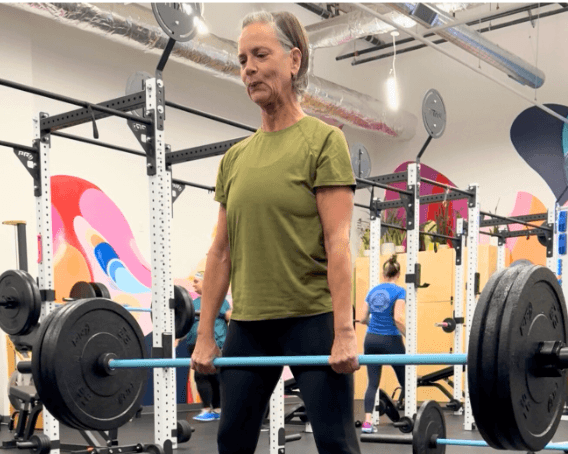
The training stimulus needs to become heavier, not longer. More load, less duration. Compound lifts at challenging weights. Short, all-out sprint intervals of 10 to 30 seconds. Fewer long sustained cardio sessions. More recovery between sessions.
Dr. Gabrielle Lyon adds the metabolic layer. Building muscle through resistance training raises your resting metabolic rate, improves insulin sensitivity, and changes what your body does with calories all day. That's what your body needs right now. Not more time in the orange zone.
The nutrition piece is just as important. Dr. Lyon recommends significantly more protein than most women are eating, distributed across meals, to actually hit the threshold that triggers muscle protein synthesis. If you're on a GLP-1 medication and your appetite is suppressed, this matters even more. Protein deficiency can sneak up on you when you're not hungry.
You're not failing the workout. The workout is failing you.
Strong Over 40 was built specifically for this. Heavy resistance training three days a week. A Kinotek movement assessment before we ever load you. A Fit3D body composition scan so you can see what's actually changing in your body, not just what the scale says. A Performance Stack with protein and creatine. A nutrition program built around supporting your hormonal environment.
For women in their late 30s and beyond who are ready to train in a way that works with their biology instead of against it.
12 spots. Starts September 28th. Get on the list now.
Resources: Sources: Dr. Stacy Sims, Next Level (2022); "Harness the Perimenopause Power Window," drstacysims.com; Huberman Lab, "Dr. Stacy Sims: Female-Specific Exercise and Nutrition for Health, Performance and Longevity" (July 2024); Dr. Gabrielle Lyon, Forever Strong (2023); drgabriellelyon.com.