
Why Your Old Training Split Stopped Working (And What We Do Instead)
Almost every new member sits down for their first conversation and tells us some version of the same story.
"I used to be in great shape." "I did chest-and-tri Mondays for a decade." "I don't know why it just stopped working."
It's not a mystery. It's not that you got lazy, and it's not that you lost your discipline. The program you were running was built for a different job than the one you're asking it to do now.
What People Actually Walk In Saying
We hear it almost word for word every week:
"My shoulder's been bugging me for two years and I just work around it." "I show up, do my split, and nothing changes anymore." "I used to bench four times a week. Now I can't remember the last time I felt strong." "I'm not trying to get big. I just want to move without thinking about it."
Notice what's missing from that list. Nobody says "I want bigger biceps." They say they want their body back.
The Split You Learned in Your 20s Was Never Built for This
Body-part splits — chest day, back day, leg day, arms — and traditional bodybuilding programming aren't wrong. They're just built for a specific goal: maximizing muscle size in individual muscles, usually for someone with young joints, low injury history, and hours to spend recovering.
That's the whole design. Isolate a muscle. Fatigue it completely. Let it rest for a week while you hammer something else. It works beautifully for the goal it was built for.
The problem is almost nobody actually has that goal, and almost nobody hits their 40s with the recovery capacity that program assumes.
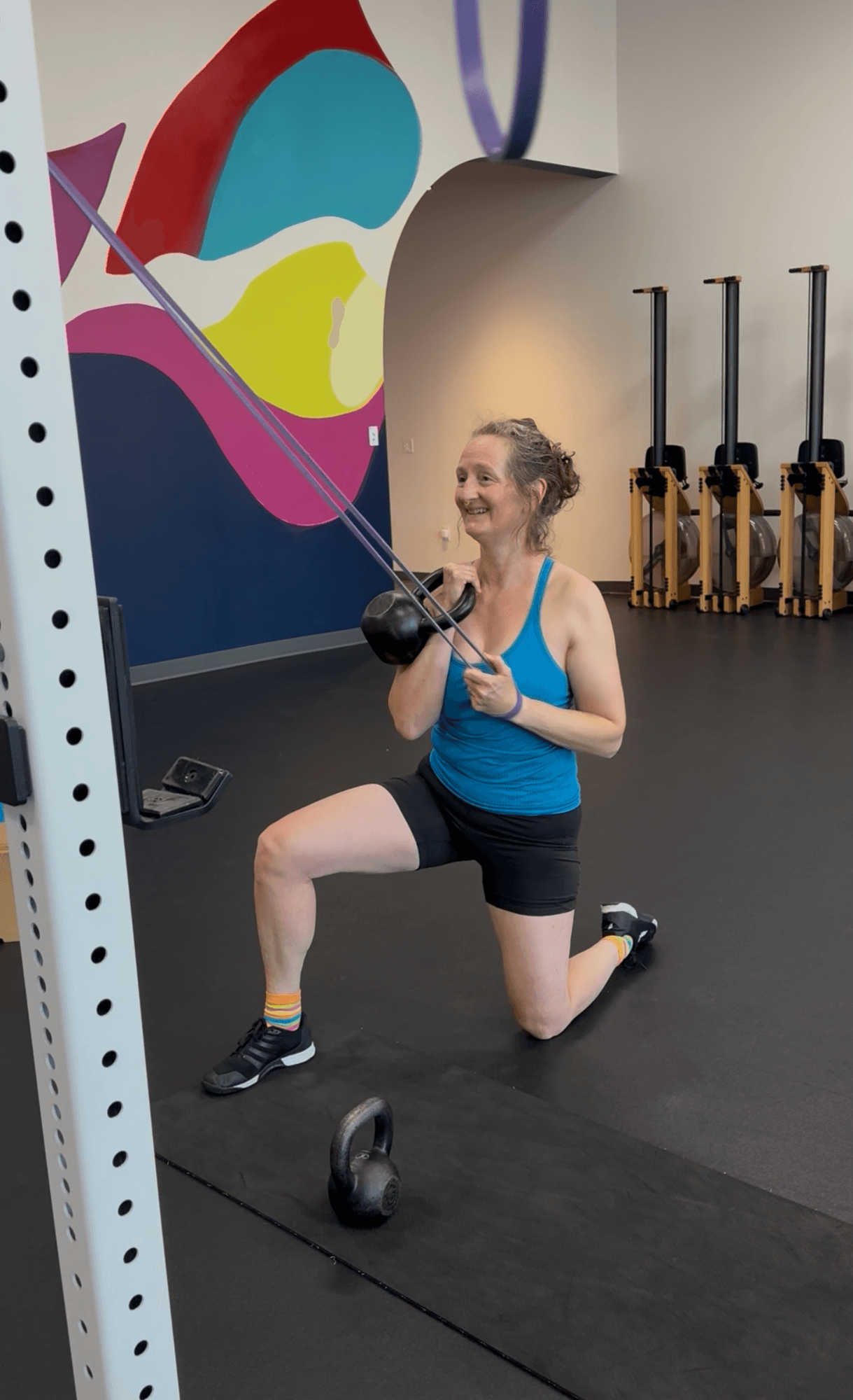 Erin performing a Filly Press to create strength, control, and balance.
Here's what tends to break down:
1- It trains muscles, not movement. A body-part split can leave your chest and shoulders strong in isolation while your body still doesn't know how to hinge, carry, or rotate under load. You can bench 225 and still throw your back out loading the dishwasher. Muscle size and real-world capability are not the same thing.
2- It skews the push-pull ratio. Most splits program chest, shoulders, and triceps generously and back work as an afterthought. Add a desk job on top of that — more pushing, more forward shoulder rounding — and you've built a program that reinforces the exact posture problem you're trying to fix.
3- It piles volume onto a small number of joints. Research on weight-training injuries consistently shows the shoulder takes the brunt of it — accounting for roughly a fifth to a third of all gym injuries — with elbow and knee close behind, largely from repetitive isolation work without enough attention to the joints doing the stabilizing.
4- It has no plan for your actual life. Splits assume you'll never miss a day, never travel, never have a rough sleep week. Miss "leg day" in a five-day split and you're either skipping a muscle group entirely or cramming it in exhausted. There's no room for a body that has a job, a family, and a nervous system that isn't 24.
5- It stops asking anything new of you. Once your chest press plateaus, a lot of programs just add more sets of the same movement instead of asking a harder question: is this still the right movement for your body?
The Uncomfortable Data Nobody Puts on a Poster
A few things worth knowing, plainly:
Strength — not just muscle size — is what predicts how well you'll move and how long you'll stay independent as you age. After 30, adults lose roughly 3–5% of muscle mass per decade, and that decline accelerates significantly after 50. Grip strength alone is one of the most reliable predictors researchers have found for mortality risk in older adults. None of that is about how your arms look in a mirror.
On the flip side, resistance training is genuinely one of the higher-leverage things you can do for longevity — research has linked it to meaningfully lower all-cause mortality, and even more so when paired with movement outside the gym. But the research also shows a ceiling: benefits plateau, and in some cases reverse, once volume climbs past a certain point without enough recovery. More sets on more isolated muscles isn't automatically more protective. Past a certain point it's just more wear.
And the honest number on adherence: roughly half of people who start a new fitness routine quit within six months. Not because the exercises were too hard. Because the program didn't fit the life it was dropped into.
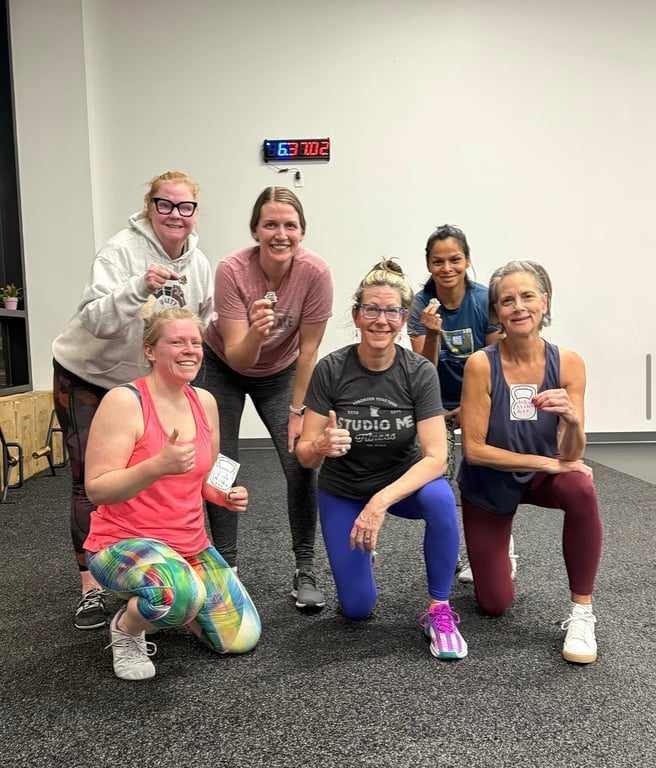 Group of members after a strength workout.
What We Do Instead
The ME Method isn't built around body parts. It's built around the 7 fundamental movement patterns — hinge, squat, lunge, push, pull, carry, rotate — because those are the patterns your body actually uses every day, whether you're in the gym or not.
We program more pulling than pushing on purpose, to counter the desk-and-phone posture most of our members are fighting against, not adding to.
We build around your training age, not your birth year, and around a real movement assessment — not a guess — so a 55-year-old with ten years of consistent training can be progressed harder than a 30-year-old who's brand new and still building a foundation.
And we cycle through phases — building movement quality first, then muscle, then strength, then performance — instead of grinding the same split until something gives out.
None of this is about training less hard. It's about training in a way your body can actually sustain, so you're not rebuilding from scratch every 18 months.
The Real Test
The old program's test was how much weight you could move in isolation. Ours is simpler: can you get off the floor without using your hands? Carry both bags of groceries in one trip without your back barking at you? Keep up on a hike five years from now?
That's the strength we're actually training for.
Curious what a movement-based program looks like for your body specifically? Book an intro and let's find out.