
Why Women Over 40 Need to Strength Train Now
I'm going to be honest with you about something.
If you've been showing up to spin class, taking group fitness, walking every day, eating well, doing everything you've been told to do, and your body still isn't responding the way you want? That's not a you problem. That's a prescription problem.
The fitness industry spent decades handing women cardio classes and low-calorie diets. And for a lot of women over 40, that approach isn't just not working anymore. It may actually be making things harder.
Dr. Stacy Sims has spent her entire career proving this. She's an exercise physiologist who focuses specifically on female physiology, and her foundational premise is this: women are not small men. Most of the research that fitness programming is built on was done on young men. The prescriptions that came out of that research got applied to everyone, including women in perimenopause and menopause whose bodies operate completely differently.
What's actually happening in your body after 40
As estrogen declines, a few specific things happen. Not vague "hormonal changes" things. Specific, documented, measurable things. Dr. Sims cites research showing that when estrogen is removed, the ability to regenerate muscle stem cells drops 30 to 60 percent. Muscle biopsies in women going through the menopause transition confirm the same thing in human tissue. Estrogen has direct muscle-building properties. When it drops, that protection goes with it.
Beyond muscle, estrogen decline also means:
- Fat shifts toward the abdomen, including visceral fat that raises metabolic and cardiovascular risk
- Bone density drops significantly, and this starts in perimenopause, not just after menopause
- Insulin sensitivity decreases, making blood sugar harder to manage and fat loss more difficult
- Recovery takes longer, because estrogen has anti-inflammatory properties that aid how you bounce back from hard sessions
And cardio doesn't fix any of this.
I want to be clear: cardio is good for you. Heart health, mental health, longevity. I'm not telling you to stop.
But cardio does not build muscle. It does not reverse the hormonal changes that are accelerating muscle loss. It does not improve bone density at the rate resistance training does. Dr. Gabrielle Lyon, who focuses on muscle as the primary organ of longevity, makes this point consistently: cardio burns calories during the workout. Muscle changes what your body does with calories 24 hours a day. Those are two completely different things.
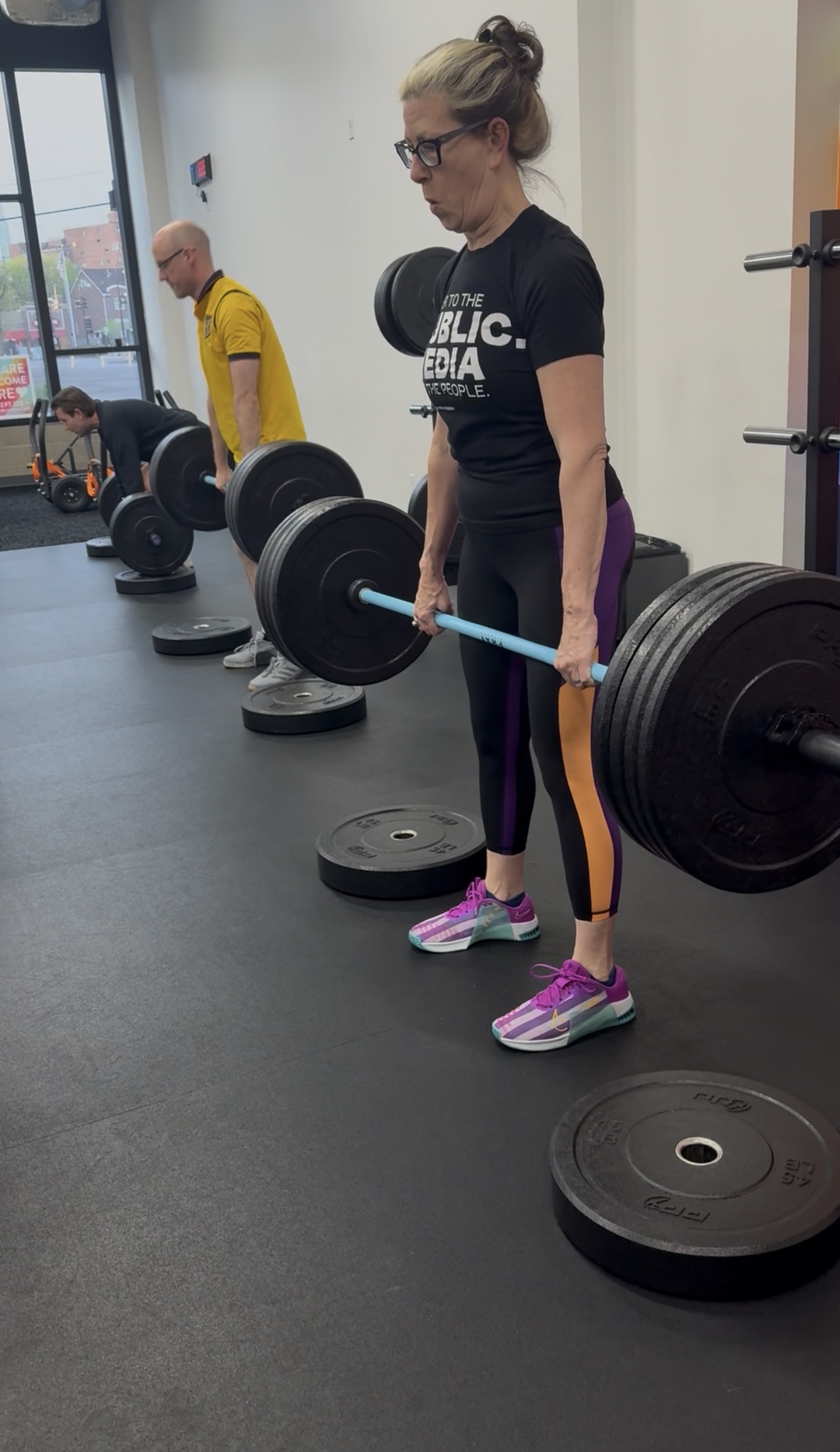 Women over 40 barbell deadlfting.
What actually works The recommendation for women in perimenopause is direct. Lift heavy. Three days a week. Compound movements. Progressive load over time. Not the light, high-rep routines that have been marketed to women for decades. That's not the stimulus your body needs right now.
When women in their 40s and beyond start structured strength training, the research is consistent. Muscle mass goes up. Bone density stabilizes. Insulin sensitivity improves. Visceral fat goes down. Joint pain often decreases. Energy comes back.
These aren't small quality-of-life wins. These are real, measurable health outcomes.
You didn't fail the program. The program failed you.
Here's what I know from coaching women in this season of life: the barrier isn't motivation. It's never been motivation. It's not having the right structure around you. Someone who programs around where your body actually is. Someone who adjusts when something isn't working. Someone who knows your numbers and holds you to them.
That's exactly what semi-private training is designed to do. Small groups, six people maximum, so your coach knows your name, your history, and your starting point. The programming is built around compound movements, progressive load, and the specific things Dr. Sims and Dr. Lyon say this population needs. Not a class. Not a template.
A program designed around you.
If you've been wondering whether strength training is the missing piece, it probably is. And if you want to do it with a coach who understands what's happening in your body right now, that's what we're here for.
Book a tour and let's talk through whether it's a fit.