
What Testosterone Loss Does to Men After 40 (and women)
Here's a number worth knowing.
Men lose about 1 percent of their testosterone per year starting in their 30s.
By 45, that's a 15 percent drop. By 55, it's 25 percent. And most men don't connect what they're feeling to what's happening hormonally. Low energy. A midsection that keeps growing no matter what. Muscle that used to come easy, now barely there. Motivation that's just not where it was. Brain fog.
They chalk it up to getting older.
That's not wrong exactly. But it's not the whole story.
What testosterone actually does Testosterone isn't just about libido or how you perform in the gym. It's a metabolic hormone that affects almost every system in your body.
Dr. Gabrielle Lyon, whose clinical work focuses on muscle health and longevity, emphasizes a concept called anabolic resistance. As we age, our bodies become less responsive to the signals that build and maintain muscle, both from the protein we eat and from the exercise we do. Declining testosterone makes this worse. Your body is fighting harder to hold onto what it has, and losing ground anyway.
Here's what that looks like in practice:
- Muscle protein synthesis slows. You're working just as hard, eating reasonably well, and still losing ground.
- Fat accumulates in the abdomen, including visceral fat that raises cardiovascular and metabolic risk. And that visceral fat further suppresses testosterone production. It's a cycle.
- Insulin sensitivity drops. Less muscle means glucose doesn't get absorbed as efficiently, which raises long-term metabolic risk.
- Recovery gets slower. Growth hormone declines with age too, which is a big part of why men in their 40s and 50s can't train the same way they did at 25.
And women aren't immune to this either. Most people think of testosterone as a male hormone. It's not exclusively. Women produce it too, and they lose it with age as well.
For women, declining testosterone compounds what estrogen loss is already doing. Less estrogen means accelerated muscle loss. Less testosterone means reduced drive, lower energy, and even slower recovery. It's one of the reasons women in perimenopause and menopause often feel like they're fighting their body on every front at once.
Dr. Stacy Sims, whose research focuses specifically on female physiology, is direct about this: the hormonal environment of women over 40 requires a different training stimulus entirely. Heavier loads. Compound movements. Progressive challenge over time. The light, high-rep classes that got marketed to women for decades don't provide that stimulus. They never did. For both men and women, the hormonal picture after 40 points to the same intervention.
What resistance training does about it Heavy compound lifts — squats, deadlifts, presses — trigger an acute hormonal response that supports both testosterone and growth hormone levels. Over time, consistent resistance training improves insulin sensitivity, reduces visceral fat, and maintains the muscle mass that hormonal decline is working against.
Dr. Lyon is direct on this: resistance training and adequate protein are the two most evidence-backed interventions available to adults over 40 for maintaining muscle and metabolic function. Not testosterone replacement as a first step. Not more cardio. Lift, and eat enough protein.
Most people also need significantly more protein than they're currently eating. As anabolic resistance increases, the threshold you need to hit to trigger muscle protein synthesis goes up. That means protein needs to be both higher in total quantity and distributed across meals throughout the day to actually work.
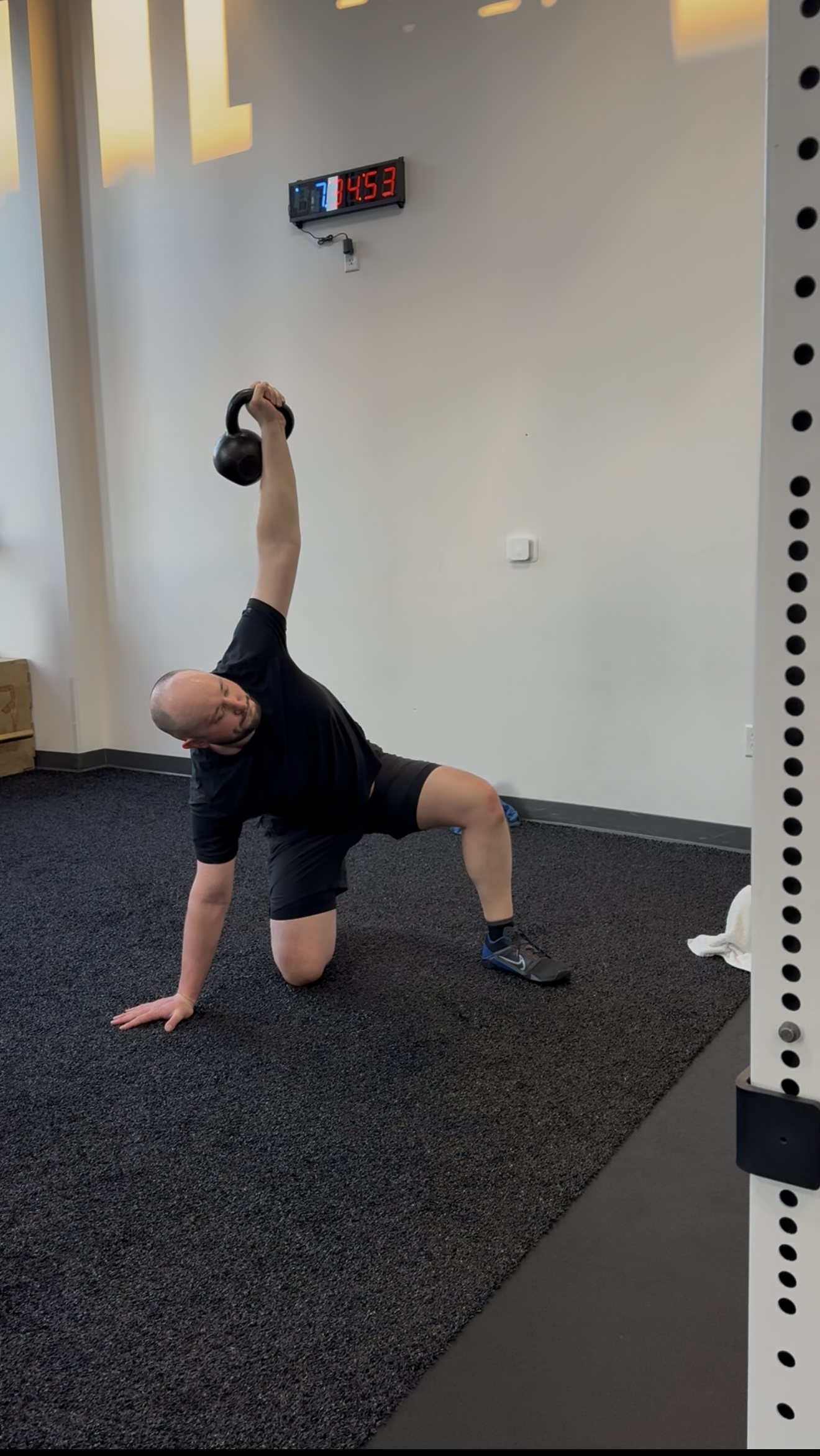 Man over 40 doing a Kettlebell Turkish Get-Up.
This is what semi-private training is designed to address. When you train in a small group - six people maximum - your coach can actually program around where you are. Your history. What's working and what isn't. That's not something that happens in a class of 20. It's also not something most people can sustain alone.
Semi-private training at Studio ME is built around compound movements, progressive load, and the specific protocols Dr. Lyon and Dr. Sims describe for this population. You get coaching that sees you. Programming that adjusts. And accountability that doesn't disappear after week two.
If you've been feeling like your body isn't responding the way it used to, it probably isn't. And that's fixable. But it takes the right stimulus.
Come see what that looks like. Book a tour and we'll walk you through exactly how we train adults in their 40s and beyond.
Sources: Dr. Gabrielle Lyon, Forever Strong (2023); Lyon G, Rountree R. "Muscle-Centric Medicine." Integrative Cancer Therapies (2024). More at drgabriellelyon.com.